


 Brochures


Dyneema® Rope: UK Manufactured, Supplied Direct to Business
English Braids is an official UK manufacturing partner for Dyneema®, producing SK75, SK78, SK99 and DM20 rope at our ISO-accredited Malvern facility. Our range covers 12-strand single braid constructions from 2mm to 32mm diameter, with pre-stretched XPS variants available for applications requiring minimal elongation under load. Where generic HMPE rope delivers inconsistent breaking strains and higher creep rates, certified Dyneema® offers a verified 8:1 weight advantage over equivalent steel wire, with elongation below 1% and up to 4x greater abrasion resilience. We supply cut lengths, reel stock and custom-finished assemblies to marine, offshore, industrial and height safety sectors. Technical datasheets, breaking strain tables and product specifications are available on each product page.
-

Dyneema® DC75 / 75XPS
SK75 Dyneema® single braid, 3–28mm to 33,500 kg spliced. For halyard cores, control lines, dinghy rigging and wire replacement. Easily inspected and field-spliced.
View Products Low Stretch ExtensionMinimal Creep ExtensionEasily Spliced SplicingHigh Break Load StrengthR5 Approved SustainabilityCoating Enhanced TreatmentsPre-Stretched TreatmentsLight Weight Weight
 -
Dyneema® DC78 / 78XPS
SK78 Dyneema® single braid, 3–26mm. Lower creep than SK75 for high-cycle halyard cores, control lines and wire replacement. XPS pre-stretched variant available.
View ProductsLow Stretch ExtensionMinimal Creep ExtensionLow Water Absorption ResistancesUV Resistant ResistancesEasily Spliced SplicingHigh Break Load StrengthR5 Approved SustainabilityLight Weight WeightPositive Buoyancy Weight -
Dyneema® DC99 / 99XPS
SK99 Dyneema® single braid, 10–26mm to 38,100 kg spliced. For safety-critical diameter constraints, halyard cores, offshore guys and high-load wire replacement.
View ProductsLow Stretch ExtensionMinimal Creep ExtensionLow Water Absorption ResistancesUV Resistant ResistancesEasily Spliced SplicingHigh Break Load StrengthR5 Approved SustainabilityPre-Stretched TreatmentsLight Weight WeightPositive Buoyancy Weight -
Steelsafe
12-strand Dyneema® in SK75, SK78, SK99 or DM20. Torsionally stable, 9–120mm, breaking loads to 597 tonnes. For heavy lifting, offshore mooring and industrial wire replacement.
View ProductsLow Stretch ExtensionMinimal Creep ExtensionTorque Balanced HandlingLow Water Absorption ResistancesUV Resistant ResistancesEasily Spliced SplicingHigh Break Load StrengthR5 Approved SustainabilityCoating Enhanced TreatmentsLight Weight Weight -
Cruising Dyneema®
Dyneema® blend core with polyester cover. Low-stretch cruising halyards and sheets for leisure and performance sailing. Stocked in multiple colours and diameters.
View ProductsLow Stretch ExtensionMinimal Creep ExtensionAnti-Kink HandlingEasy to Handle HandlingEasily Spliced SplicingR5 Approved SustainabilityHeat Treated TreatmentsPre-Stretched TreatmentsLight Weight Weight -
Racing Dyneema® Pro
SK78 Dyneema® 12-strand core with 24-plait polyester jacket. Pre-stretched halyards and sheets, 8–24mm, for high-cycle keelboat racing and performance cruising.
View ProductsLow Stretch ExtensionMinimal Creep ExtensionAbrasion Resistant ResistancesLow Water Absorption ResistancesUV Resistant ResistancesEasily Spliced SplicingHigh Break Load StrengthR5 Approved SustainabilityHeat Treated TreatmentsPre-Stretched TreatmentsHard Wearing WearLight Weight Weight -
Dynastay
DM20 Dyneema® 12-strand rope, 3–13mm. Minimal permanent creep for forestays, backstays and synthetic standing rigging. Pre-stretched and field-spliceable.
View ProductsMinimal Creep ExtensionChemical Resistant ResistancesLow Water Absorption ResistancesUV Resistant ResistancesEasily Spliced SplicingHigh Break Load StrengthPre-Stretched TreatmentsLight Weight Weight -
Winching Dyneema
SK78 Dyneema® core with 24-plait polyester jacket. Sheathed synthetic winch rope, 8–24mm, for commercial and industrial winching. Jacket maintains rope roundness under drum pressure.
View ProductsLow Stretch ExtensionMinimal Creep ExtensionAbrasion Resistant ResistancesLow Water Absorption ResistancesUV Resistant ResistancesEasily Spliced SplicingHigh Break Load StrengthPre-Stretched TreatmentsHard Wearing WearLight Weight Weight -
Racing Dyneema®
SK75 Dyneema® 12-strand core with 24-plait polyester jacket. Pre-stretched racing halyards and sheets, 8–16mm, for club racing and performance sailing.
View ProductsLow Stretch ExtensionMinimal Creep ExtensionAbrasion Resistant ResistancesLow Water Absorption ResistancesUV Resistant ResistancesEasily Spliced SplicingHigh Break Load StrengthPre-Stretched TreatmentsHard Wearing WearLight Weight Weight -

Continuous Control Line
Purpose-built for endless loop dinghy control systems. Dyneema® SK75/polyester cover, polypropylene core, 4mm. Smooth running through blocks and cleats.
View ProductsLow Stretch ExtensionLow Water Absorption ResistancesUV Resistant ResistancesEasily Spliced SplicingHard Wearing WearLight Weight Weight -
D-Racer 16
SK78 Dyneema® core with flexible 16-plait polyester cover, 3–6mm. Easily spliced and taperable dinghy halyards and sheets in four twist mix colour combinations.
View ProductsLow Stretch ExtensionMinimal Creep ExtensionLow Water Absorption ResistancesUV Resistant ResistancesEasily Spliced SplicingHigh Break Load StrengthHard Wearing WearLight Weight Weight -
Dinghy Dyneema®
SK78 Dyneema® 12-strand core with 32-plait polyester cover, 1–6mm. Hard-wearing dinghy halyards, sheets and control lines with colour-matched core for easy splicing.
View ProductsLow Stretch ExtensionMinimal Creep ExtensionAbrasion Resistant ResistancesLow Water Absorption ResistancesUV Resistant ResistancesEasily Spliced SplicingHigh Break Load StrengthHard Wearing WearLight Weight Weight -
Superyacht Dockline Dyneema®
100% Dyneema® SK75 core with polyester cover. Bespoke superyacht mooring lines, 24–40mm, factory spliced with chafe protection in polyester, Dyneema® or leather.
View ProductsLow Stretch ExtensionEasy to Handle HandlingAbrasion Resistant ResistancesLow Water Absorption ResistancesUV Resistant ResistancesEasily Spliced SplicingHigh Break Load StrengthR5 Approved SustainabilityHard Wearing Wear -
Dynamic Line DC12
SK75 Dyneema® 12-strand single braid with impregnated coating, 2–10mm to 8,500 kg. For soft shackles, dinghy rigging and dynamic wire replacement. SK78/SK99/DM20 on request.
View ProductsLow Stretch ExtensionMinimal Creep ExtensionLow Water Absorption ResistancesUV Resistant ResistancesEasily Spliced SplicingHigh Break Load StrengthHard Wearing WearLight Weight Weight -
Steelsafe Ultra
SK78 Dyneema® long lay core with 24-plait polyester cover. 22–44mm, 26.9–134.3 tonnes spliced. For offshore lifting, commercial winching and wire rope replacement.
View ProductsLow Stretch ExtensionMinimal Creep ExtensionAbrasion Resistant ResistancesLow Water Absorption ResistancesUV Resistant ResistancesEasily Spliced SplicingHigh Break Load StrengthHard Wearing Wear -
D-Tract
HMPE 12-strand winch rope with optimised pitch and protective coating, 9–16mm. Dyneema-equivalent break loads for 4x4 winching and vehicle recovery. Made to order.
View ProductsLow Stretch ExtensionMinimal Creep ExtensionLow Water Absorption ResistancesUV Resistant ResistancesEasily Spliced SplicingHigh Break Load StrengthHard Wearing WearLight Weight Weight












Why Dyneema?
- 8:1 Weight Advantage Over Steel
At just 1/7th the weight of equivalent steel wire, Dyneema® allows for smaller, safer and more ergonomic rigging systems. Neutral buoyancy (SG 0.97) ensures full crane capacity is maintained at any depth without the penalty of self-weight, and eliminates the handling fatigue associated with steel wire during deployment and recovery.
- Ultra-Low Elongation
With elastic stretch typically below 1%, Dyneema® eliminates "rope bounce" and provides millimetre-accurate control for precision lifting. This low-energy state also drastically reduces "snap-back" hazards compared to high-stretch polyester or steel.
- 4x Longer Service Life
Engineered to manage the FACTs (Fatigue, Abrasion, Creep, and Temperature), our Dyneema® range offers up to 4x the abrasion resilience of generic HMPE. Specific grades like SK78 and DM20 are further optimised to virtually eliminate permanent creep.
- 90% Lower Carbon Footprint
English Braids utilizes mass-balanced circular feedstocks that reduce CO_2 emissions by up to 29 tonnes per tonne of fibre compared to fossil-based HMPE. You achieve the same certified Minimum Breaking Load (MBL) while meeting rigorous Scope 3 ESG targets.
- Superior Axial Thermal Conductivity
Dyneema® is a thermal-engineered thermoplastic. While it has a melting point of 145°C, its unique molecular alignment allows for high axial thermal conductivity (20W/m.K), dissipating heat along the fibre length 100x faster than standard polymers. This makes it exceptionally resilient in high-friction winch environments where internal core fusion is a risk for generic HMPE.
- 90% TCLL Fatigue Resilience
Our Dyneema® range is benchmarked against TCLL (Thousand Cycle Load Level) standards. While generic HMPE often fails under high-frequency cyclic loading, our SK78 fibres maintain over 90% of their original breaking strength after 1,000 load cycles. This reduces Total Cost of Ownership (TCO) by extending the safe operational window between replacements.

Experience unparalleled strength & reliability - speak to our expert team today
Dyneema® Grade Comparison: SK75, SK78, SK99 and DM20.
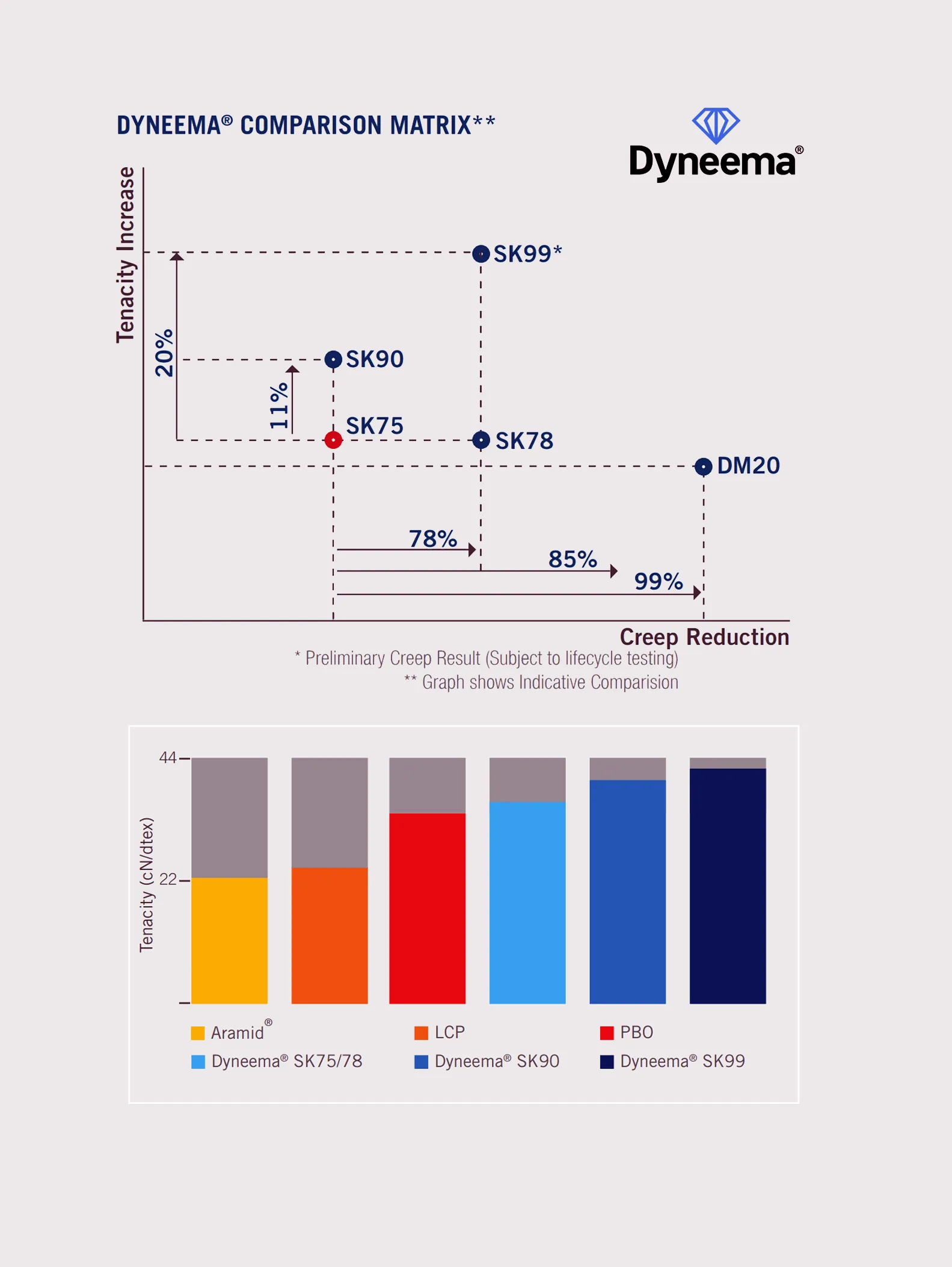
Real-world reliability is dictated by the FACTs: Fatigue, Abrasion, Creep, and Temperature. This matrix provides the markers required to ensure a lower Total Cost of Ownership (TCO).
Dyneema® SK75 (The Proven Standard)
The established specification for general marine, lifting and industrial rigging. Delivers an 8:1 weight advantage over steel with consistent, certified breaking loads, suited to high-volume applications where creep resistance is not the primary requirement.
Dyneema® SK78 (The Global Benchmark)
The default choice for high-cycle winching, mooring and running rigging. Offers 90% TCLL fatigue resilience over 1,000 high-load cycles, where dimensional stability under sustained load is operationally critical.
Dyneema® SK99 (Elite Performance)
Delivers a 20% strength advantage over SK78 at equivalent diameter. The specification of choice for grand-prix racing, deep-water lifting and offshore applications where diameter and weight margins are non-negotiable.
Dyneema® DM20 (Zero-Creep Static)
Engineered for permanent static installations: standing rigging, structural tethers and long-term load-bearing applications. DM20 exhibits virtually zero permanent creep where geometry and safety margins cannot drift.
Steel-to-Synthetic Efficiency Matrix
Transitioning from steel wire to Dyneema® delivers a dramatic improvement in strength-to-weight efficiency. At an equivalent breaking strain, our solutions offer a 7:1 weight advantage, significantly reducing crew fatigue and the Total Cost of Ownership (TCO) of deck hardware.
Efficiency Study: 500kN Strength Target
To achieve a 50-tonne (500kN) breaking capacity, the weight differential between synthetic and steel is transformative:
| Material | Diameter | Weight/100m |
|---|---|---|
| Dyneema® SK78 | 24mm | 32kg |
| Steel Wire (1770 N/mm²) | 28mm | 324kg |
Result: 90% Weight Saving per metre
Kinetic Safety & Energy Management
Unlike steel wire, which acts as a massive spring, Dyneema® has ultra-low elastic elongation. Upon failure, the stored potential energy is significantly lower, causing the line to drop inertly rather than “snapping back” with lethal velocity.


