


 Brochures


Dyneema® Fibre Technology: Grades, Science and Applications
Dyneema® is a branded ultra-high-molecular-weight polyethylene fibre produced by Avient under a patented gel-spinning process. The gel-spinning aligns polymer chains to a degree unachievable with standard HMPE extrusion, producing a fibre with tensile strength of 3.6 GPa and specific gravity of 0.97, which makes it lighter than water and 8 times stronger than steel at equivalent weight. English Braids is an official UK licensed manufacturer, producing rope from SK75, SK78, SK99 and DM20 branded fibre. Grade selection is determined by the specific load profile and application, with key variables being creep behaviour, tenacity ceiling and molecular architecture.
This page covers the technical properties of each Dyneema® grade, how branded Dyneema® differs from generic HMPE, and Avient’s mass-balanced sustainability programme. For diameter specifications, breaking loads and trade enquiries, see our Dyneema® rope range.
Dyneema® vs Generic HMPE: The Technical Distinction
All Dyneema® is ultra-high-molecular-weight polyethylene (UHMWPE), commonly referred to in the rope and marine industry as HMPE, but not all HMPE is Dyneema®. Generic HMPE is produced by standard extrusion, which achieves partial polymer chain alignment. Dyneema® is produced by Avient’s patented gel-spinning process, which aligns polymer chains to over 95%, a degree unachievable through standard extrusion, resulting in a fibre that is hydrophobic, UV-resilient, chemically inert, and dimensionally consistent batch to batch. Generic HMPE products often exhibit inconsistent breaking strains and higher creep rates precisely because that molecular alignment is incomplete and variable.
Dyneema® delivers 15 times the specific strength of steel at fibre level, a weight-for-weight tenacity comparison measured in cN/dtex. In practical rope system terms this becomes an 8:1 weight saving, when a Dyneema® rope is sized to match the minimum breaking load and diameter of an equivalent steel wire rope. The difference between the two figures reflects braiding geometry losses, the need to maintain diameter for hardware compatibility, and the density ratio of steel to UHMWPE (7.85 vs 0.97).
English Braids, UK Dyneema® Rope Manufacturer Since the 1990s
English Braids has manufactured rope using Dyneema® fibre since the 1990s, when the fibre was produced by DSM and later acquired by Avient. We operate under ISO 9001 quality management from our Malvern facility, producing Dyneema® rope from 0.8mm diameter across 8-plait, 12-strand, 16-plait, 24-plait and 32-plait constructions, with single-braid, cored and sheathed variants available across the range. All SK78 Dyneema® fibre used in our production is MEG4 compliant at fibre level, ensuring consistent molecular specification across every batch.
We also produce hybrid constructions that blend Dyneema® with polyester, nylon and aramid fibres, combining the tenacity and low weight of UHMWPE with the abrasion resistance, heat tolerance or elongation characteristics of complementary textiles. Custom splice terminations, assemblies and bespoke rope systems are handled by our Special Works department, where staff carry over 40 years of experience in splicing and technical rope assembly. Custom lengths, colour coding, coating specifications and made-to-order constructions are available on enquiry.
What are the Different Types of Dyneema®?
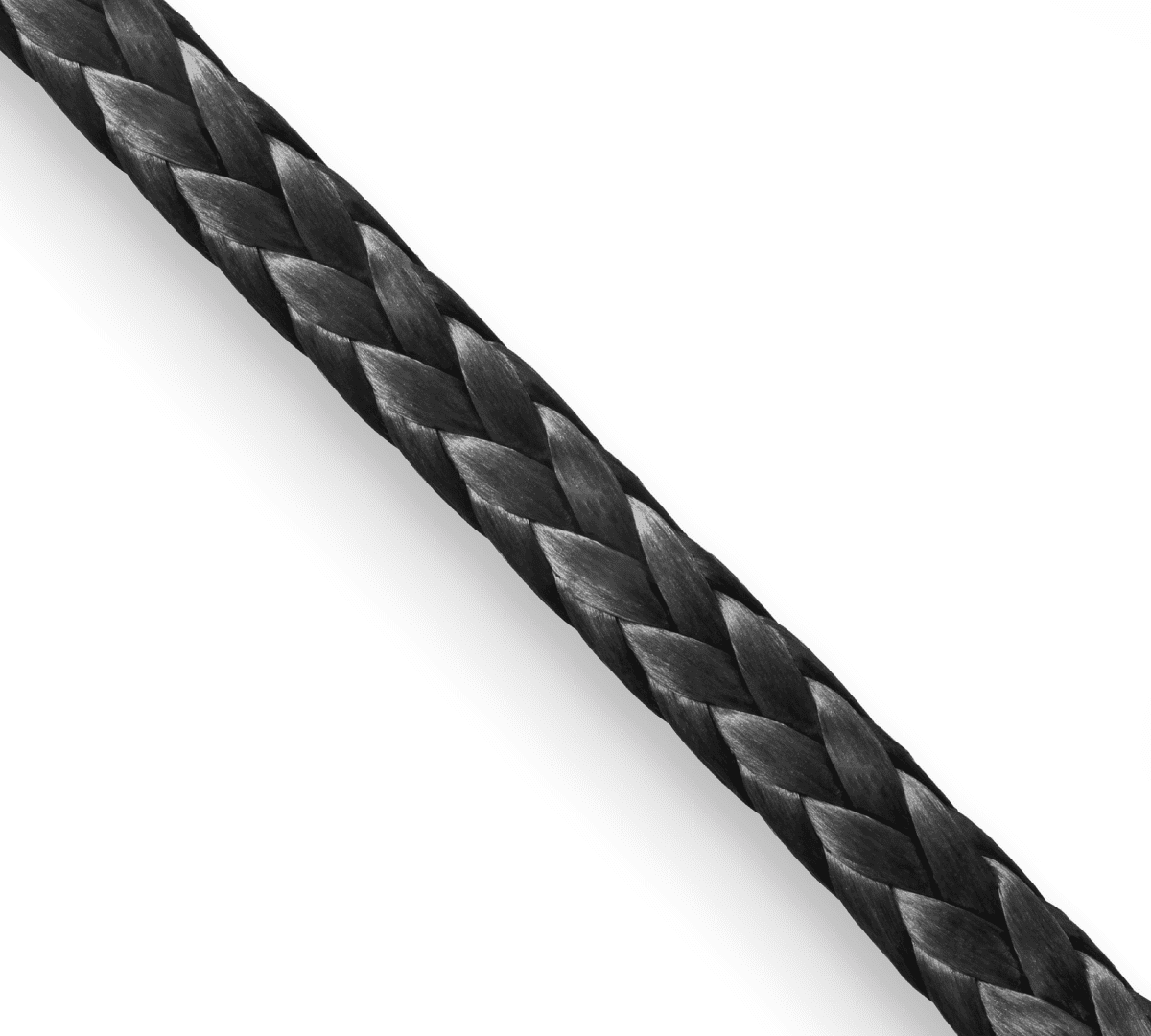
Dyneema® SK75
(The Proven Standard): SK75 achieves a tenacity of 2.5-3.4 N/tex with a tensile modulus of 109-132 GPa and elongation at break of 3-4%, produced via gel-spinning with greater than 95% polymer chain alignment and over 85% crystallinity. Creep rate under sustained load is 0.02%/day at 30°C and 300 MPa, with an initial primary creep period of hours to days as the rope beds in. Where load is dynamic, cycle times are short and sustained static tension is not a design condition, the 78% creep improvement of SK78’s molecular anchor architecture carries no operational benefit and SK75 is the correct grade specification.
View Product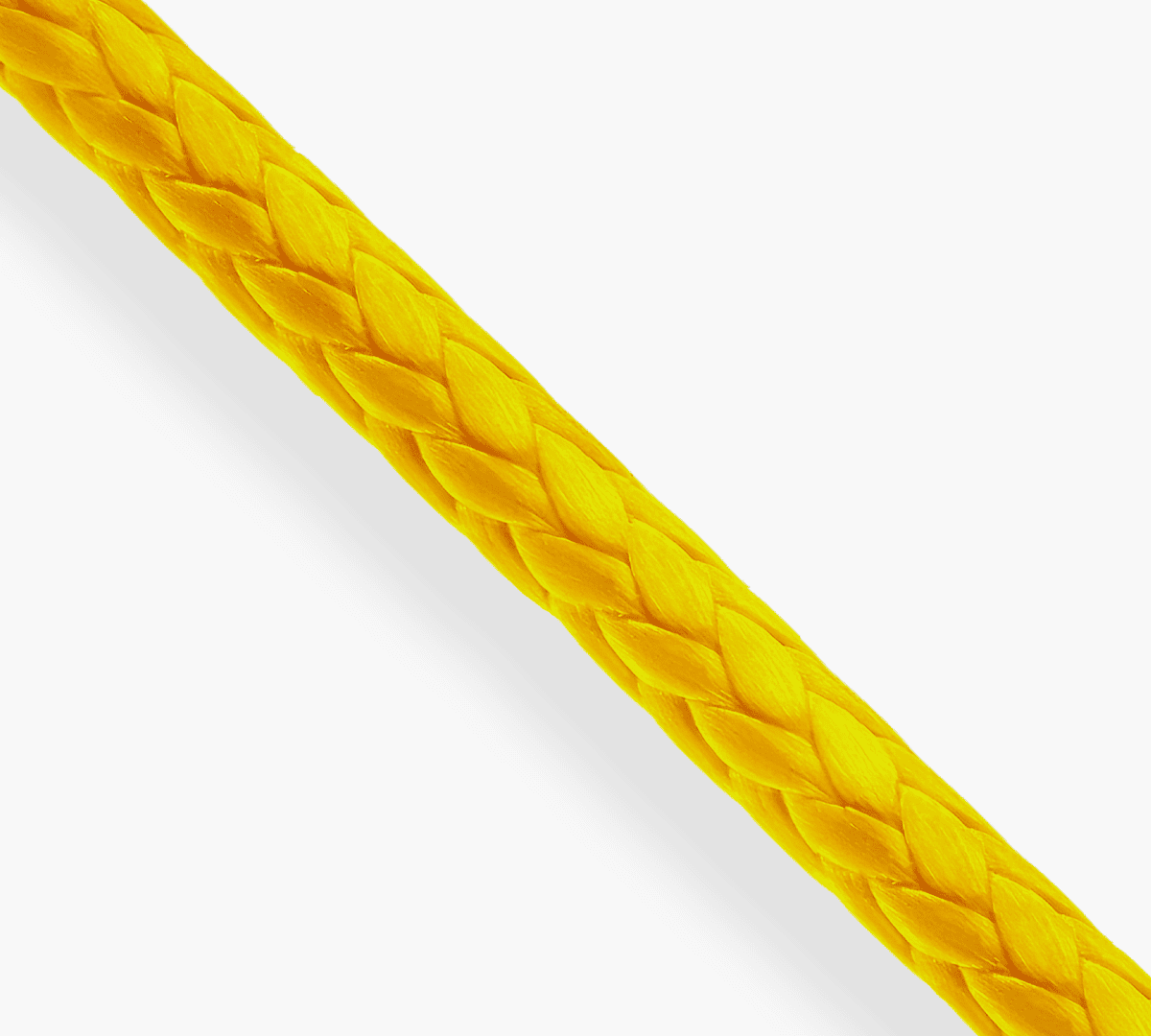
Dyneema® SK78
(The High-Cycle Standard): SK78 achieves a tenacity of 3.4-4.0 N/tex with a tensile modulus of 109-132 GPa and elongation at break of 3-4%, produced with engineered side chains introduced into the polymer backbone. These molecular anchors prevent long-chain sliding under static and fatigue loading, the primary creep mechanism in standard UHMWPE. The result is a measured creep rate of 0.006%/day at 30°C and 300 MPa, a 78% reduction against SK75’s 0.02%/day, with up to 4x the creep life of generic HMPE. SK78 is accredited by DNV GL, Bureau Veritas and ClassNK, and specifically surpasses all OCIMF MEG4 test requirements at fibre level.
View Product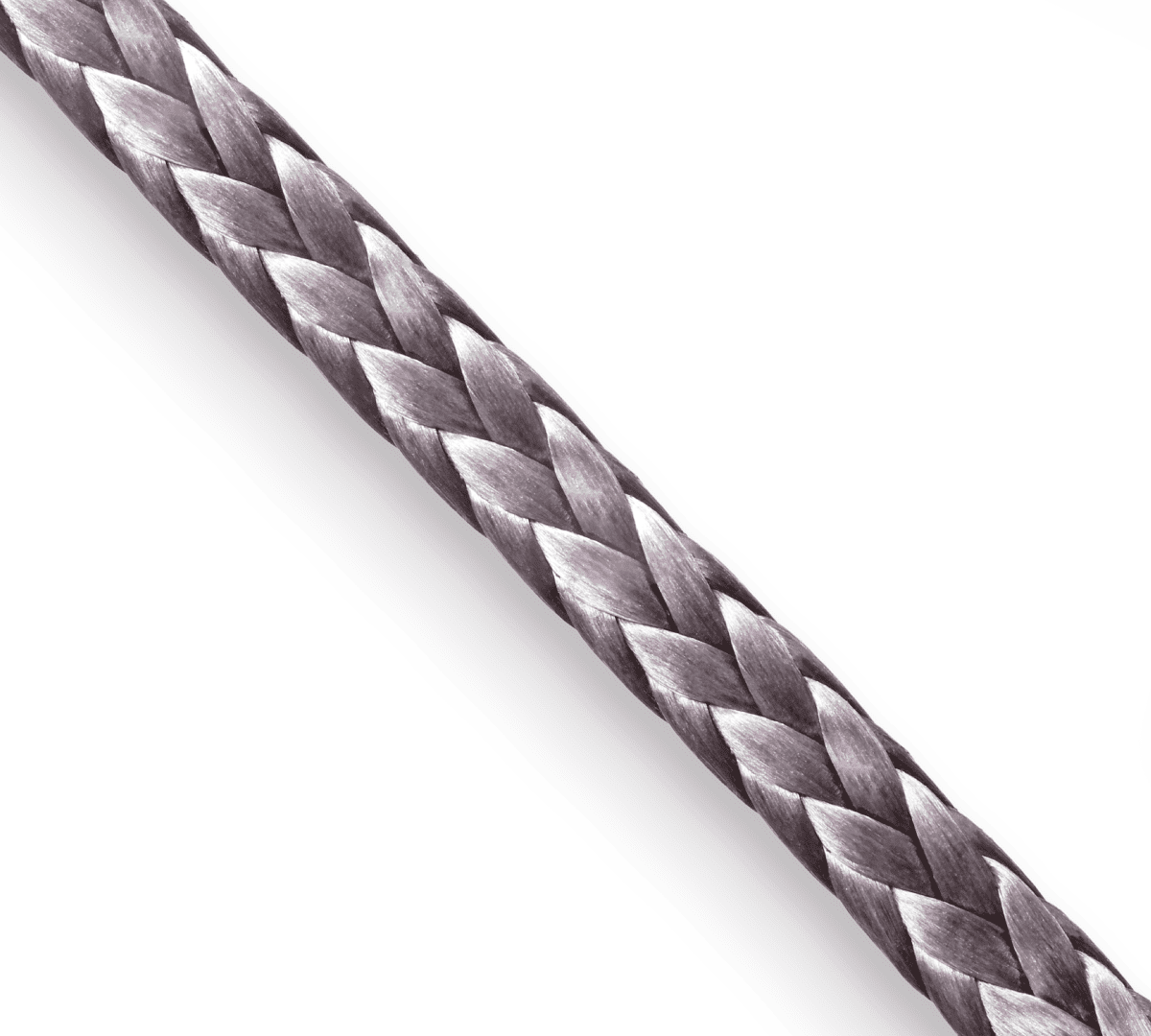
Dyneema® SK99
(Maximum Tenacity): SK99 achieves a nominal tenacity of 42.5 cN/dtex with a fibre modulus of 1,590 cN/dtex, produced via heat-stretching at fibre level. It delivers a 20% tenacity increase over SK75/SK78 alongside a preliminary creep reduction of 99% versus the SK75 baseline, against SK78’s confirmed 85%. The higher modulus makes SK99 stiffer than SK78, with reduced grip in some rope clutches and greater sensitivity to tight bend radii. Specifying SK99 purely to reduce rope diameter increases the percentage of breaking load carried in service, which can accelerate creep and negate the strength advantage. For dynamic applications or systems with standard hardware, a cored construction with a polyester sheath mitigates both the handling and hardware compatibility constraints while retaining the SK99 tenacity advantage.
View Product
Dyneema® DM20
(Zero Permanent Creep): DM20 achieves a measured creep rate of 0.00007%/day at 30°C and 300 MPa, against SK75’s 0.02%/day and SK78’s 0.006%/day, with a calculated creep lifetime exceeding 250 years under permanent mooring conditions. It meets the permanent mooring industry requirement of less than 0.5% elongation over 25 years in service. The trade-off is tenacity: DM20’s nominal tenacity of 31-32 cN/dtex sits below the SK series, and its lower modulus of 94 GPa means a DM20 rope requires approximately 25% larger diameter than SK75 to achieve equivalent breaking load. DM20 is the correct specification for permanent static installations where dimensional stability over decades is the primary design constraint and tensile headroom allows for the diameter increase.
View ProductFor tailored solutions and expert advice on our Dyneema® ropes, please reach out to our professional team.
Discover how English Braids can support your next project.
A Future Beyond Fossils: Mass-Balanced Dyneema®
Avient’s mass-balance programme integrates bio-circular feedstocks, collected from byproducts of the wood, pulp and timber industries, directly into the standard Dyneema® production process using an ISCC-certified allocation model. The bio-circular input reduces CO2 emissions by 3.76 tonnes per metric tonne of fibre produced versus fossil-based production, with 95% of fibre manufacturing powered by renewable electricity.
The programme currently covers SK78, SK99 and DM20. Mechanical properties across all three grades are independently verified as identical to fossil-based production by DNV Approval of Manufacturing and Type Approval certification. Avient has discontinued the separate “bio-Dyneema” brand designation: the mass-balanced benefits are now standard across the covered grades rather than a separately purchasable variant.
For B2B partners with Scope 3 reduction commitments, specifying English Braids Dyneema® rope from SK78, SK99 or DM20 provides a verified drop-in solution with no requalification of MBL or diameter specifications required.
View our sustainability promise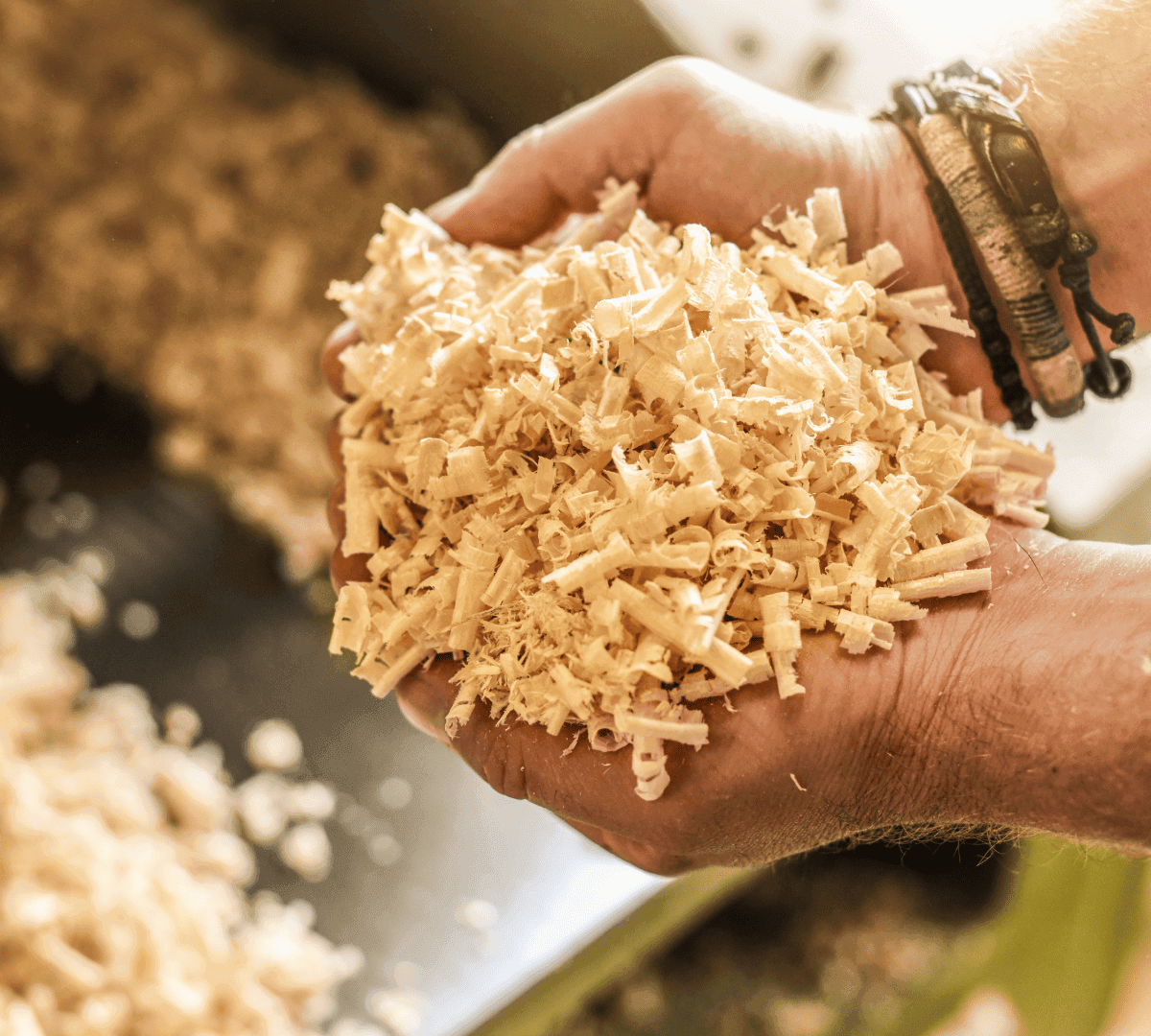
Dyneema® Industries and Applications
Dyneema® ropes find extensive application across multiple industries, including:
-

Leisure Marine
Leisure Marine
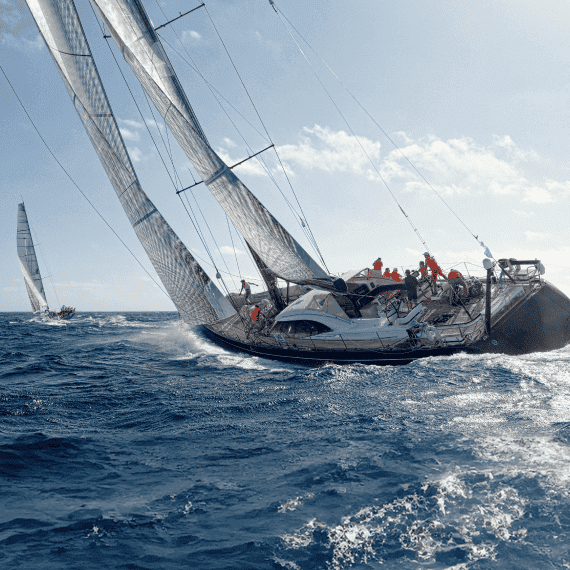
Dyneema®'s near-zero elongation at break (3-4%) and hydrophobic molecular structure make it the specification standard for racing halyards, sheets and control lines. No moisture absorption means no weight gain aloft, no creep under sustained rig tension, and consistent load transfer in conditions where polyester stretch introduces control lag.
View Market -
Industrial Applications
Industrial Applications
At 0.97 specific gravity against steel's 7.85, a Dyneema® lifting line sized to match steel's minimum breaking load operates at roughly 15% of the mass. The handling safety consequence is direct: lower kinetic energy in a failure event, reduced snap-back radius, and manual deployment without mechanical assistance on lines that would require crane handling in steel.
View Market -
Offshore Operations
Offshore Operations
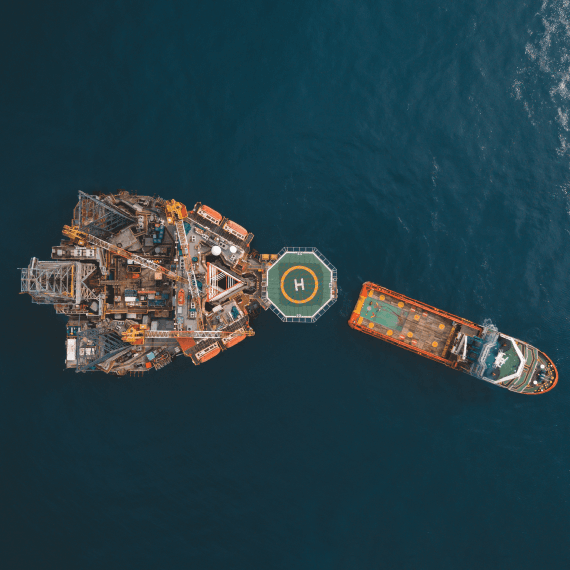
Dyneema® is neutrally buoyant in seawater, eliminating the self-weight loading that limits steel wire at depth. For permanent mooring and subsea tether applications, DM20 provides a calculated creep lifetime exceeding 250 years at rated load, meeting the permanent mooring industry requirement of less than 0.5% elongation over 25 years in service.
View Market -

4x4 & Vehicle Winching
4x4 & Vehicle Winching
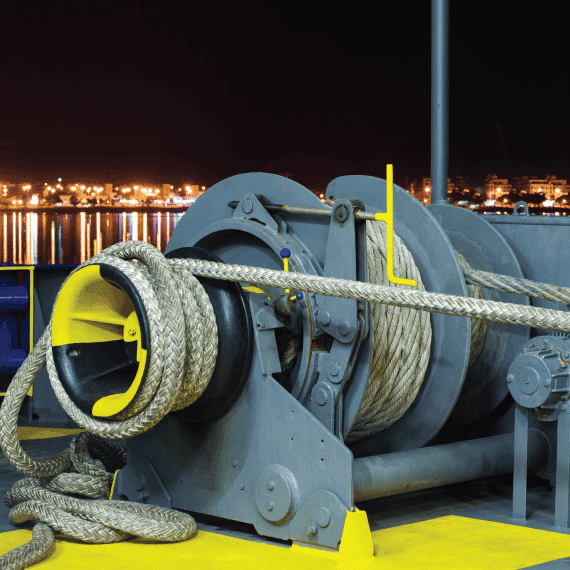
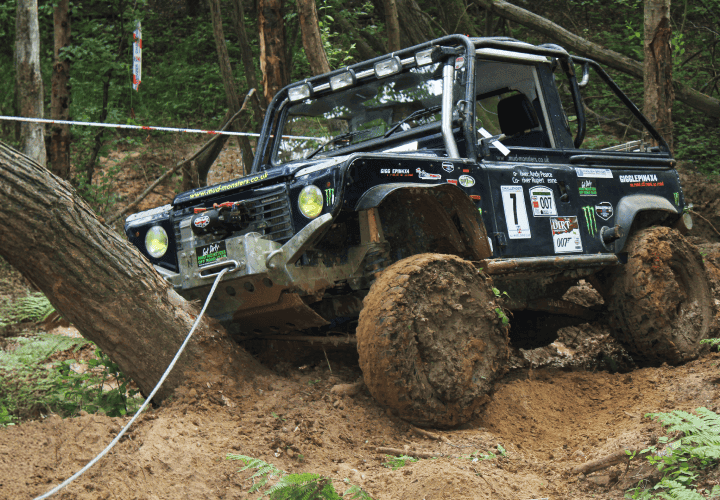
SK75 and SK78 winch lines operate at roughly 15% of the mass of equivalent-rated steel cable, eliminating the primary injury risk in vehicle recovery: stored elastic energy on a parted line. Dyneema® does not kink, birdcage or fatigue at the drum in the way steel cable does under repeated spool-and-unspool cycling, and floats clear of mud and water during recovery.
View Market -
Safety and Rescue
Safety and Rescue
The combination of 3-4% elongation at break, hydrophobic fibre chemistry and UV resilience produces a rescue rope that holds rated load without moisture-induced strength loss or UV degradation in extended field deployment. At equivalent breaking load to steel, the rope mass is reduced by approximately 87%, directly reducing rescuer fatigue and improving deployment speed in time-critical extractions.
View Market -
Floating Offshore Wind
Floating Offshore Wind
Permanent mooring tethers for floating wind platforms require a fibre that holds dimensional stability over a 25-year design life under continuous dynamic loading. DM20's calculated creep lifetime exceeds 250 years at rated load, meeting the permanent mooring requirement of less than 0.5% elongation over 25 years. At neutral buoyancy in seawater, the mooring system self-weight penalty that limits steel catenary design at depth is eliminated.
View Market -

Theatre & Events
Theatre & Events
Zero-stretch at operational loads allows precise positional repeatability in flying rigs and camera systems where polyester elongation would require constant trim compensation. Dyneema® lines running through standard blocks and clutches produce no audible creak under load, relevant for live broadcast and recorded performance environments where wire noise is an operational constraint.
View Market -

Agriculture & Forestry
Agriculture & Forestry
The hydrophobic fibre surface does not absorb water, so a Dyneema® winch line maintains consistent weight and handling characteristics in wet field conditions where polyester or nylon lines increase in mass and stiffness. At failure, low stored energy means the line drops rather than recoils, reducing the snap-back hazard that makes steel winch cable failures dangerous in confined forestry operations.
View Market -

Aquaculture & Fishing
Aquaculture & Fishing
Dyneema®'s hydrophobic surface and 0.97 specific gravity produce netting that does not waterlog, maintaining consistent mesh geometry and reducing drag through the water column. Lower drag reduces trawl fuel consumption and, in cage aquaculture, improves water flow and oxygen exchange through the net wall without requiring larger mesh apertures that would compromise containment integrity.
View Market




Quality Assurance and Traceability
English Braids operates under ISO 9001 quality management, audited by SGS, covering rope manufacturing at our Malvern facility. Every Dyneema® production run carries full batch traceability from Avient fibre intake through to finished rope, with fibre grade, construction and batch reference recorded and retained for a minimum of 10 years.
Published MBL figures for Dyneema® constructions are derived from spliced rope testing to ISO 2307, not bare fibre data. UHMWPE’s ultra-low friction coefficient means friction-based terminations are not valid for HMPE; the Spliced Minimum Break Load (SMBL) of the tested assembly is the only defensible strength figure. English Braids publishes SMBL figures from documented test data.
MBL testing is conducted in-house on an AJT 55-tonne tensile testing machine at Malvern, within the group up to 80 tonnes, and at TTI Testing in Wallingford for third-party certification or loads above 80 tonnes. For offshore and safety-critical applications, DNV-accredited raw material certification is available on SK78 to DNVGL-OS-E303. Certificates of conformity are available on request at no additional charge.

Dyneema® Technical Data Sheets
Independent performance data published by Avient, the fibre manufacturer for Dyneema®. Each document covers a specific property of Dyneema® fibre tested under controlled laboratory and real-world conditions.
- Chemical Resistance of Dyneema® Fibre
Tensile strength test data across inorganic acids, alkalis, organic solvents, oils, seawater and aviation fluids. Zero strength loss recorded across the majority of tested chemicals over up to 5,000 hours of exposure.
Download Data Sheet - UV Resistance of Dyneema® Fibre
Accelerated weathering data comparing Dyneema® against polyester, aramid, LCP and PBO. Dyneema® retains significantly greater tensile strength than all alternative fibre types over 700 hours of UV exposure per ISO 4892-2.
Download Data Sheet - Outdoor Use of Ropes Made with Dyneema® Fibre
Ten-year outdoor exposure data on braided rope samples by diameter. Includes real-world data from oil tanker mooring lines showing 75% strength retention after 23,000 mooring hours of weather, abrasion and tensile loading.
Download Data Sheet - Creep Resistance of Dyneema® Fibre
Grade-by-grade creep rate comparison at sustained load. DM20 achieves a predicted lifetime of 250 years at 0.0%/year. Dyneema® proven to have the lowest creep rate of all commercially available UHMWPE fibre grades.
Download Data Sheet


